Blog

  • Prepare for interview

    Liz Teige is the Vice President and Head of the Innovation Hub at RepRisk AG, a Zurich-based ESG data science company. With a tenure at RepRisk since 2010, she has progressed through roles including Analyst, Senior Analyst, Research Manager, and Vice President of Research Technology, culminating in her current leadership position citeturn0search8.

    Professional Experience:

    • RepRisk AG: As Vice President and Head of the Innovation Hub, Liz is responsible for fostering, accelerating, and enhancing product, process, and general business innovation throughout the company. She plays a pivotal role in developing ESG due diligence tools, such as the company’s disaggregated ESG risk scores, which provide insights into specific sustainability risks within companies’ operations and supply chains citeturn0search2.

    • Peace Corps: Prior to joining RepRisk, Liz spent two years in the Dominican Republic with the United States Peace Corps, contributing to community development initiatives citeturn0search8.

    Education:

    • Bachelor’s degree in English Literature from the University of Virginia

    • Master’s degree in International Relations from the Johns Hopkins School of Advanced International Studies (SAIS)

    Expertise and Interests:

    • ESG Risk Management: Liz emphasizes the importance of stakeholder-driven data in identifying and mitigating ESG risks, particularly greenwashing. She advocates for transparency and comprehensive risk assessments to build resilient and sustainable business practices citeturn0search4.

    • Sustainable Investing: She has participated in discussions on sustainable investing and net-zero transitions, highlighting the need for granular ESG data to inform investment decisions and address interconnected environmental, social, and governance risks citeturn0search6.

    Preparation Tips for Interview:

    • Discuss Innovation in ESG: Be prepared to talk about your experience with innovative approaches to ESG risk assessment and how data-driven solutions can enhance transparency and accountability.

    • Explore Stakeholder-Driven Data: Understanding the value of stakeholder perspectives in ESG evaluations can be crucial. Discuss how incorporating such data can lead to more comprehensive risk assessments.

    • Highlight Cross-Functional Collaboration: Given Liz’s role in fostering innovation across products and processes, sharing experiences where you’ve collaborated across departments to drive innovation can be beneficial.

    For more detailed information, you can view her LinkedIn profile here: linkedin.com/in/lizteige.

    =====

    Philippa Eby is a seasoned professional with extensive experience in business development and commercial real estate. She currently serves as the Director of Business Development at Ames Construction, Inc., and is also a Commercial Realtor with U.S. Commercial Realty. In her role at Ames Construction, Philippa focuses on building relationships to create opportunities for the company to undertake new projects. She emphasizes the importance of connecting with the community and has engaged in educational outreach to explain her role to younger audiences. citeturn0search3

    Professional Experience:

    • Ames Construction, Inc.: As Director of Business Development, Philippa is responsible for identifying and cultivating new business opportunities. She works closely with project teams to ensure the successful execution of construction projects, such as the Cross Keys Place Shopping Center in Doylestown, PA. citeturn0search4

    • U.S. Commercial Realty: In her capacity as a Commercial Realtor, Philippa assists clients in buying, selling, and leasing commercial properties. Her dual roles allow her to provide comprehensive services that bridge construction and real estate.

    Preparation Tips for Interview:

    • Discuss Business Development Strategies: Be prepared to talk about your experience in identifying new business opportunities and building client relationships.

    • Explore Construction Project Management: If you have experience in overseeing construction projects or coordinating with various stakeholders, be ready to share these experiences.

    • Highlight Community Engagement: Philippa values community involvement, so discussing any outreach or educational initiatives you’ve participated in could resonate well.

    For more detailed information, you can view her LinkedIn profile here: linkedin.com/in/philippaeby.

    =====

    Nikolaos Kolitsas is a software engineer with extensive experience in building machine learning solutions. He is currently associated with RepRisk, a Zurich-based company specializing in ESG (Environmental, Social, and Governance) data analytics. citeturn0search0

    Professional Experience:

    • RepRisk AG: At RepRisk, Nikolaos contributes to the development of machine learning models that enhance the company’s ESG data analysis capabilities. His work likely involves designing algorithms that process large datasets to identify and assess ESG risks.

    Technical Skills and Interests:

    Nikolaos’s expertise lies in machine learning, with a focus on creating solutions that can handle complex data structures and deliver actionable insights. His role requires a deep understanding of data science principles and the ability to apply them to real-world problems in the ESG domain.

    Preparation Tips for Interview:

    • Discuss Machine Learning Projects: Be prepared to talk about your experience with machine learning, particularly projects that involved processing large datasets or developing predictive models.

    • Explore ESG Data Analytics: Given his role at RepRisk, discussing your understanding or experience with ESG data, its challenges, and its significance in today’s business environment can be beneficial.

    • Highlight Problem-Solving Skills: Emphasize instances where you’ve tackled complex technical challenges, especially those related to data analysis or algorithm development.

    For more detailed information, you can view his LinkedIn profile here: linkturn0search0.

    ====

    Adelin Jitea is a seasoned software engineer and technology leader with a strong focus on Java development and a commitment to producing maintainable, reusable, and straightforward code. Currently serving as a Technology Lead at RepRisk AG, a Zurich-based company specializing in ESG (Environmental, Social, and Governance) data analytics, he plays a pivotal role in guiding technical teams and ensuring the delivery of high-quality software solutions citeturn0search0.

    Professional Experience:

    • RepRisk AG: In his role as Technology Lead, Adelin is instrumental in driving the development of scalable and efficient systems that support ESG data analysis. His responsibilities likely include overseeing software architecture, mentoring development teams, and ensuring the alignment of technical strategies with business objectives.

    Technical Skills and Interests:

    Adelin’s expertise lies primarily in Java, where he emphasizes the importance of clean and maintainable code. His approach to software development is characterized by a focus on simplicity and reusability, which are crucial for building robust and adaptable systems citeturn0search0.

    Preparation Tips for Interview:

    • Discuss Java Development Practices: Be prepared to talk about your experience with Java, particularly in writing clean, maintainable, and reusable code. Sharing examples of how you’ve applied these principles in past projects can resonate well.

    • Explore ESG Data Analytics: Given his role at RepRisk, discussing your understanding or experience with ESG data, its challenges, and its significance in today’s business environment can be beneficial.

    • Highlight Leadership and Collaboration: If you have experience leading technical teams or collaborating across departments to achieve project goals, be ready to share these experiences, as they align with Adelin’s leadership role.

    For more detailed information, you can view his LinkedIn profile here: linkturn0search0.

    ===

    Liviu Malaescu is a seasoned technology leader with a strong background in software engineering and IT infrastructure management. He currently serves as a Senior Software Engineer and Technology Lead at RepRisk AG, a Zurich-based company specializing in ESG (Environmental, Social, and Governance) data analytics citeturn0search1.

    Professional Experience:

    • RepRisk AG: In his current role, Liviu leads software development initiatives, focusing on building scalable and efficient systems to support ESG data analysis. His work involves integrating complex data sources and ensuring the reliability of RepRisk’s technology infrastructure.

    • Haier Europe: Previously, Liviu held the position of DT Service Desk & Workplace Manager at Haier Europe. In this capacity, he managed IT service desks and workplace solutions, contributing to the company’s digital transformation efforts citeturn0search2.

    Technical Skills and Interests:

    Liviu possesses a deep understanding of system-level programming and hardware-software interactions. He has demonstrated interest in low-level computing topics, such as CPU instruction sets and performance optimization, indicating a strong grasp of computer architecture citeturn0search6.

    Creative Pursuits:

    Beyond his technical career, Liviu engages in creative activities like pencil art and videography. He shares his artwork on Instagram and videos on Vimeo, reflecting a well-rounded personality with both analytical and artistic talents citeturn0search3.

    Preparation Tips for Interview:

    • Discuss ESG Data Analytics: Given his role at RepRisk, be prepared to talk about ESG data analysis, challenges in data integration, and the importance of data reliability in this context.

    • Explore System-Level Topics: Liviu’s interest in low-level computing suggests he values efficiency and performance. Discuss experiences related to system optimization or handling complex technical challenges.

    • Highlight Cross-Functional Skills: His background spans both software development and IT infrastructure. Emphasize any experience you have that bridges these areas.

    • Acknowledge Creative Interests: Recognizing his artistic pursuits can help build rapport and show appreciation for a balanced skill set.

    For more detailed information, you can view his LinkedIn profile here: linkturn0search1.

  • Clean Architecture

    1. Software architecture is about minimizing human resources and maximizing productivity

    The goal of software architecture is to minimize the human resources required to build and maintain the required system.

    Architectural decisions matter. Good architecture reduces the effort required to develop, deploy, and maintain software systems. It allows teams to work independently, minimizes the impact of changes, and enables the system to evolve over time.

    Key aspects of good architecture:

    • Separation of concerns
    • Dependency management
    • Abstraction of implementation details
    • Flexibility to accommodate future changes

    By focusing on these aspects, architects can create systems that are easier to understand, modify, and extend, ultimately leading to increased productivity and reduced costs over the system’s lifetime.

    2. Clean architecture separates business rules from external details

    The center of your application is not the database. Nor is it one or more of the frameworks you may be using. The center of your application is the use cases of your application.

    Business rules are the core. Clean architecture organizes code into concentric circles, with business rules at the center and implementation details at the outer layers. This separation allows the core business logic to remain unaffected by changes in external factors such as databases, user interfaces, or frameworks.

    Key layers in clean architecture:

    • Entities: Enterprise-wide business rules
    • Use Cases: Application-specific business rules
    • Interface Adapters: Convert data between use cases and external agencies
    • Frameworks and Drivers: External tools and technologies

    By adhering to this structure, developers can create systems that are:

    • More flexible and adaptable to change
    • Easier to test and maintain
    • Less dependent on specific technologies or frameworks

    3. SOLID principles guide the creation of flexible, maintainable systems

    The SOLID principles tell us how to arrange our functions and data structures into classes, and how those classes should be interconnected.

    SOLID enhances modularity. These five principles provide guidelines for creating software systems that are more understandable, flexible, and maintainable. They help developers design code that is resistant to changes and easy to extend.

    The SOLID principles are:

    • Single Responsibility Principle: A class should have only one reason to change
    • Open-Closed Principle: Software entities should be open for extension but closed for modification
    • Liskov Substitution Principle: Objects of a superclass should be replaceable with objects of its subclasses without affecting the program’s correctness
    • Interface Segregation Principle: Many client-specific interfaces are better than one general-purpose interface
    • Dependency Inversion Principle: High-level modules should not depend on low-level modules; both should depend on abstractions

    By applying these principles, developers can create more robust and scalable software architectures that can adapt to changing requirements over time.

    4. Components are the building blocks of a clean architecture

    Components are the units of deployment. They are the smallest entities that can be deployed as part of a system.

    Modular design enables flexibility. Components in clean architecture are independently deployable and developable parts of the system. They encapsulate related functionality and have well-defined interfaces, allowing for easier maintenance and modification of the system.

    Key characteristics of well-designed components:

    • High cohesion: Related functionality grouped together
    • Low coupling: Minimal dependencies between components
    • Clear interfaces: Well-defined methods of interaction
    • Independent deployability: Can be updated or replaced without affecting other parts of the system

    By organizing systems into components, architects can:

    • Facilitate parallel development by different teams
    • Enable easier testing and debugging
    • Allow for incremental updates and improvements to the system
    • Improve overall system scalability and maintainability

    5. Boundaries define and protect the core business logic

    At each architectural boundary, we are likely to find the Humble Object pattern lurking somewhere nearby.

    Boundaries protect the core. Architectural boundaries in clean architecture separate different areas of concern, particularly between business logic and implementation details. These boundaries help maintain the independence of the core business rules from external changes.

    Key aspects of architectural boundaries:

    • Use of interfaces to define interactions between layers
    • Dependency inversion to ensure that dependencies point inward
    • Data transfer objects to pass information across boundaries
    • Humble objects to separate testable behavior from hard-to-test components

    By establishing clear boundaries, architects can:

    • Minimize the impact of changes in external systems or technologies
    • Facilitate easier testing of core business logic
    • Enable the replacement of implementation details without affecting the core system
    • Improve overall system flexibility and adaptability

    6. Clean architecture facilitates test-driven development and independent deployability

    A good architecture makes the system easy to change, in all the ways that it must change, by leaving options open.

    Testability and flexibility are key. Clean architecture promotes practices that make systems easier to test and deploy independently. By separating concerns and managing dependencies, it becomes simpler to write unit tests for core business logic and to deploy different components of the system separately.

    Benefits of clean architecture for testing and deployment:

    • Core business rules can be tested without UI, database, or external dependencies
    • Different components can be deployed independently, allowing for easier updates
    • Changes in one area of the system have minimal impact on others
    • New features can be added with less risk of breaking existing functionality

    These characteristics lead to:

    • Faster development cycles
    • Reduced risk in deployments
    • Improved system reliability
    • Greater flexibility in adopting new technologies or changing existing ones

    7. Frameworks and databases are implementation details, not architectural elements

    Frameworks are tools to be used, not architectures to be conformed to.

    Core logic should be framework-agnostic. Clean architecture treats frameworks and databases as external details that should not influence the core business logic. This approach allows for greater flexibility in changing or updating these external elements without affecting the system’s core functionality.

    Key principles for handling frameworks and databases:

    • Treat them as plugins to the core business logic
    • Use dependency inversion to keep core logic independent
    • Create abstractions for database operations
    • Delay framework and database decisions as long as possible

    Benefits of this approach:

    • Easier to change or upgrade frameworks and databases
    • Core business logic remains stable despite external changes
    • Reduced vendor lock-in
    • Improved testability of core system components

    8. The web is just another delivery mechanism in clean architecture

    The web is a delivery mechanism, and your application architecture should treat it as such.

    Business logic is delivery-agnostic. In clean architecture, the web is treated as an external detail, similar to databases or frameworks. This perspective allows the core business logic to remain independent of the specific delivery mechanism, whether it’s a web application, desktop app, or API.

    Key considerations for web applications in clean architecture:

    • Separate web-specific code from core business logic
    • Use interface adapters to convert between web formats and internal data structures
    • Treat web frameworks as plugins to the core system
    • Design use cases to be independent of web-specific concerns

    Benefits of this approach:

    • Easier to adapt the system to different delivery mechanisms
    • Core business logic can be reused across multiple platforms
    • Simplified testing of business rules without web dependencies
    • Greater flexibility in changing or updating web technologies

    9. Clean embedded architecture separates hardware concerns from business logic

    Although software does not wear out, it can be destroyed from within by unmanaged dependencies on hardware.

    Hardware independence is crucial. Clean embedded architecture applies the principles of clean architecture to embedded systems, separating hardware-specific concerns from core business logic. This separation allows for easier updates to hardware components and improved portability of the software.

    Key elements of clean embedded architecture:

    • Hardware Abstraction Layer (HAL) to isolate hardware-specific code
    • Device-independent business logic
    • Clear interfaces between hardware and software components
    • Use of dependency inversion to manage hardware dependencies

    Benefits of this approach in embedded systems:

    • Easier to port software to new hardware platforms
    • Simplified testing of core logic without hardware dependencies
    • Reduced impact of hardware changes on overall system
    • Improved maintainability and longevity of embedded software

    10. Microservices and service-oriented architectures can benefit from clean architecture principles

    The architecture of a system is defined by boundaries that separate software elements from one another, and restrict those on one side from knowing about those on the other.

    Clean principles apply at all scales. While clean architecture is often discussed in the context of monolithic applications, its principles can be effectively applied to microservices and service-oriented architectures. These principles help maintain the independence and testability of individual services while managing the complexity of distributed systems.

    Applying clean architecture to microservices:

    • Treat each microservice as a bounded context with its own clean architecture
    • Use well-defined interfaces for inter-service communication
    • Apply dependency inversion between services
    • Maintain independent deployability of services

    Benefits of clean architecture in microservices:

    • Improved modularity and scalability of the overall system
    • Easier to understand and maintain individual services
    • Greater flexibility in evolving and replacing services
    • Reduced coupling between services, leading to more robust systems
  • SnelStart Notes

    Use this link by translating to understand:
    Suppliers in SnelStart 12

    Boekhouden — book keeping
    Afscrhiften Inlezen — bank account statement reading (MT940 as the format to be loaded)
    Bankieren –> Bank Account management

    Klanten — Clients and their details
    Leveranciers — Suppliers and their details
    BTW Nummer == VAT Number

    Omzet groep == Revenue group which links to VAT
    Hoog BTW = High VAT is applicable for non-food products
    Laag BTW = Low VAT is applicabile for food products
    Geen BTW == No VAT is applicable when we are selling to other country within EU

    Facturen — Invoicing

    Btw Aangifte — VAT Filing , quarterly basis –> April 1st week, July 1st Week, October 1st Week, and January 1st week
    ICP Aangifte — only required when exports to other EU countries, monthly basis

    Boekjaar afsluiten — closing books for a year

    Kolommenbalans == Balance Sheet

    W&V (Winst [Profit] & Verlies [Loss])
    Balans ==> Balance Sheet

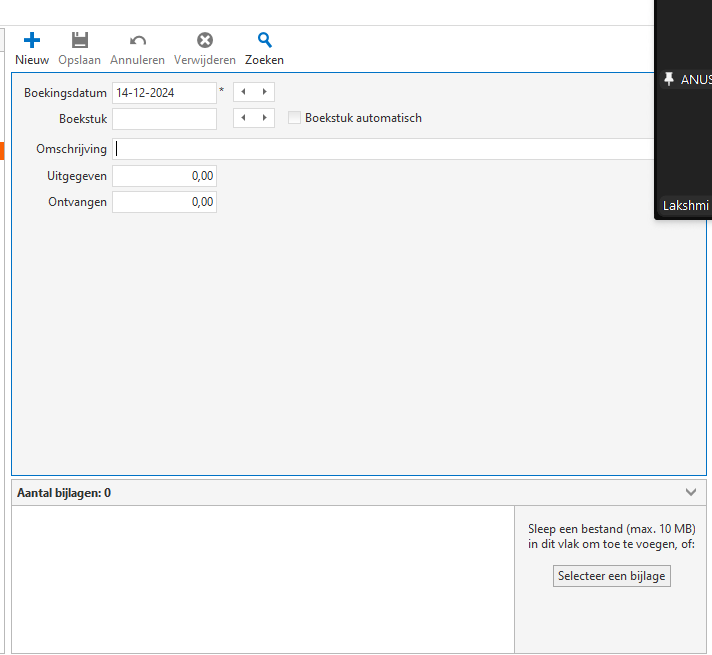
    For creating a new entry into the bank transactions, use following screen

    boekingsdatum – booking date
    omschrijving – is the description as presented in the csv / excel file from the statement received

    You must only use on of the following:
    Uitgegeven – (payment) –
    Ontvangen – (receipt) –

    Preferably add the file in the attachment
    Pasted image 20250316104958.png

  • CCSP – Cloud Security Professional (ISSC)

    #acloudguru

    There are 3 key layers as part of cloud

    • Service Layer
      • SaaS
      • PaaS
      • IaaS
    • Resource abstraction and control layer
      • Hypevisor
      • VMs
    • Physical resource layer
      • CPU
      • NIC
      • Firewall
      • Storage
      • HVAC

    Internet types of connectivity (network based connectivity):

    • Internet
    • Redundancy
    • Capacity
    • Support many types of end point devices
  • Rx

    Functional Reactive Programming (We’re Reactive)
    Iterables
    Revanath is the DR

    it’s Responsive, Resilient, Elastic, Message Driven
    Implements Observer pattern in a better way. It has good multi-threading, thread safe methods to work with data and data events.
    It’s Observables + LINQ + Schedulers

  • Rx

    Functional Reactive Programming (We’re Reactive)
    Iterables
    Revanath is the DR

    it’s Responsive, Resilient, Elastic, Message Driven
    Implements Observer pattern in a better way. It has good multi-threading, thread safe methods to work with data and data events.
    It’s Observables + LINQ + Schedulers

  • Python

    This page provides the required pythong programming skills which are developed

    GPU Processing:
    http://fastml.com/running-things-on-a-gpu/

    https://www.modular.com/mojo
    https://github.com/HigherOrderCO/Bend

  • Information

    Policy => Standards

    Standards should be Uniform and Mid-Level
    These are tactical

    Standards guide "Procedures"

    Procedures are being drafted by Lakshmi to be taken forward based on standards and policies.

    Guidelines == Operational:

    • provide direction on how to implement, deploy
    • optional recommendations not compulsory
      Baselines
    • Min. set level
    • can also be set a standard by external entity
  • Hello world!

    Welcome to WordPress. This is your first post. Edit or delete it, then start writing!